With AI Writing the Code, Is Your Team Delivering More?
AI Forward Deployed Engineering
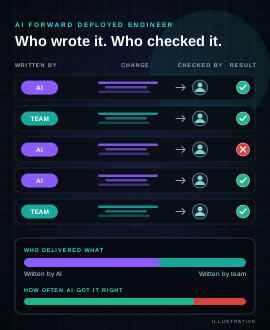
Our AI forward deployed engineers worked inside a customer's engineering team to rebuild its code review and team productivity metrics for a world where AI writes much of the code. The result shows what was written by AI, what each team member delivered and checked, and how many times the AI got it right or wrong. AI raises the output; the team still owns the outcome.
What is an AI forward deployed engineer?
A forward deployed engineer does not ship a tool and leave. They sit with the customer's team, learn how work really flows, and build against the customer's own code and process until the result holds up. An AI forward deployed engineer, also called an AI forward deployment engineer, does this for AI: coding assistants, agents, review automation and the metrics around them.
Embedded, not external
Works in the team's repositories, pipelines and stand-ups, so the solution fits how the team already works.
Builds, not advises
Writes the integrations, review rules and dashboards, and stays until they are trusted.
Tuned to one customer
Generic AI tooling gives generic results. The engineer calibrates it on the customer's own code and standards.
Why code review and productivity metrics broke when AI started writing code
The customer's engineers had adopted AI coding tools quickly. Output went up, and so did the questions nobody could answer.
Old metrics counted the wrong thing
Commits, lines changed and pull requests per engineer all rose. None of them showed whether a person or an AI did the work, or whether it was good.
Review could not keep up
More code meant more and larger pull requests, often related to each other, while the number of reviewers stayed the same.
Nobody knew how often AI was right
Leaders were asked whether AI was worth it. The honest answer was that no one had measured it.
Security wanted a clear checker
An AI agent writing code and the same engineer approving it left no independent check on the change.
Code review and team metrics customised to AI-written and human-written code
Working alongside the customer's engineers, we customised their code review and productivity metrics around one idea: every change should say who wrote it, and be judged by what happened to it.
AI vs human authorship
Each pull request records how much of the change was written by AI and how much by a team member, so the two can be reported separately.
How often the AI got it right
AI-written changes are followed to their outcome: merged as written, changed before merge, rejected, or reverted later.
Team productivity that is fair
Metrics no longer reward raw volume. A person's contribution and the AI's contribution are measured on their own terms.
Multi-pull-request review automation
Automated review that reads related pull requests together, so a change spread across several of them is judged as one.
AI code governance
Rules for where AI may write code, which checks AI-written code must pass, and an audit trail of every AI-written change.
Maker-checker security
The maker of a change, human or AI, can never be its checker. AI-authored code needs a named human approver.
Engineering delivery, code quality and AI ROI in one view
The same data that drives review also answers the leadership questions. We group the metrics by the decision they support.
Engineering delivery
Lead time from first commit to merge, review turnaround, pull request size and throughput, split by AI-written and human-written work.
Code quality
Rework before merge, changes reverted or fixed after merge, review findings and test results, for AI and for people.
AI accuracy
The share of AI-written changes accepted as written, changed, rejected or reverted, by repository, language and type of task.
Review health
Who reviews what, how long changes wait, and whether maker-checker rules were met on every merge.
Governance and security
AI-written changes by area of the codebase, policy exceptions, and the audit record behind each approval.
AI ROI
Time and effort AI assistance saves, set against the review and rework it creates, so its return can be stated plainly.
We do not publish this customer's figures. The definitions above are tuned per team: what counts as "right" for AI in one codebase is not the same in another, which is why an engineer has to be deployed forward to set it up.
How an AI forward deployed engineer cracks it
Embed
Join the team, read the repositories and watch how code is written and reviewed today.
Instrument
Capture who or what wrote each change, at the point it is written and proposed.
Automate review
Add automated multi-pull-request review and the maker-checker rule to the merge process.
Calibrate
Agree with the team what "right" and "wrong" mean for AI output, and tune until the numbers are trusted.
Hand over
Dashboards, rules and documentation owned by the customer's team, with us on call.
For engineering leaders who need answers about AI, not opinions
CTOs and VPs of Engineering
You are asked what AI coding tools return, and you want a number you can defend.
Engineering managers
You want to recognise good work fairly when AI writes part of it.
Security and compliance
You need proof that AI-written code was checked by an accountable person.
Platform and DevEx teams
You own the review process and the developer tooling, and both are under strain.
Questions about AI forward deployed engineers and AI code review
What is an AI forward deployed engineer?
An AI forward deployed engineer is an engineer who works inside the customer's team instead of handing over a product from outside. They learn how the team really works, then build and tune AI tooling against the customer's own code, data and processes until it delivers a result. The role is also written as AI forward deployment engineer or FDE.
How do you tell AI-written code from human-written code?
Attribution is recorded at the point the code is written and proposed, using signals such as the coding assistant or agent that produced a change, commit and pull request metadata, and the author's own declaration. Each pull request then carries a record of how much of it was written by AI and how much by a team member. The exact signals depend on the tools the team uses.
How do you measure whether the AI got the code right?
Each AI-written change is followed after it is proposed. It counts as right when it is approved and merged without rework and stays in the codebase, and as wrong when reviewers reject it, when it needs changes before merge, or when it is later reverted or fixed. Tracking those outcomes over time shows where AI can be trusted and where it needs closer review.
What is maker-checker in code review?
Maker-checker is a control where the party that makes a change cannot be the one that approves it. For AI-written code it means an AI agent can author a pull request, but a named human who did not write it must approve it before merge. It gives security and audit teams a clear record of who checked what.
What is AI code governance?
AI code governance is the set of rules that decides where AI may write code, what checks AI-written code must pass, and who is accountable for it. It usually covers which repositories and file types are allowed, required reviews and tests, handling of secrets and licences, and an audit trail of AI-written changes.
Why do normal engineering productivity metrics stop working with AI?
Measures such as lines of code, commit counts and pull requests per engineer assumed a person wrote every change. When an assistant or agent writes a large share, those numbers rise without telling you whether delivery or quality improved. Metrics have to separate AI work from human work and judge both by outcome.
Let's Talk: 30 Minutes on AI in Your Engineering Team.
Skip the back-and-forth. Pick a time that works for you, tell us which AI coding tools your team uses and what you cannot measure today, and we'll come prepared with how a forward deployed engineer would start.
Gain the advantage of foresight with Mindslake
Mindslake is on a mission to democratize AI, making it easier for startups to integrate AI solutions into their websites and applications.
Our Latest Project
Explore our cutting-edge projects and solutions that demonstrate our expertise and innovation in the world. We believe that technology should be a force for good

Marketing Analytics Dashboard: Tracking Conversions. Driving Growth.
Achievements: Data-backed decisions to improve conversions, align sales and marketing, and measure ROI across campaigns.

Fintech Portfolio Intelligence
Real-Time Insights for Smarter Investment Decisions
