Cloud Cost Management for AWS, Azure and GCP, Without Hiring a FinOps Team
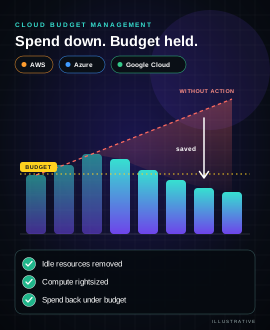
Cloud Budget Management · FinOps
Cloud bills grow quietly: an oversized cluster here, a forgotten environment there. Mindslake has helped customers reduce costs on Azure, AWS and Google Cloud, and we can manage your cloud budget as an ongoing service. If you are looking for people to take ownership of cloud spend, our cost management engineers can start with your bill this week.
Cloud cost optimisation that engineering and finance both trust
Good cloud cost management is not a one-off clean-up. It is a routine: finance knows what the money buys, engineers see the cost of their own choices, and nobody is surprised at month end. We set that routine up and run it with you.
See it
Every line of the bill mapped to a team, a product and an environment. One dashboard across AWS, Azure and GCP.
Cut it
The savings levers worked in order of effort and return, with each change agreed with the team that owns the workload.
Keep it
Budgets, alerts, anomaly detection and a monthly review, so costs stay down after the first round of fixes.
Twelve ways we reduce cloud spend
Most cloud waste sits in the same few places on every provider. We check each of them against your usage data and act on the ones that pay back.
Rightsizing compute
Virtual machines, containers and databases matched to what they really use, from utilisation data and not from guesswork.
Commitment discounts
AWS Savings Plans and Reserved Instances, Azure Reservations and savings plans, and Google committed use discounts, sized to your steady baseline.
Idle and orphaned resources
Unattached disks, old snapshots, forgotten load balancers, unused IP addresses and test environments nobody owns.
Scheduling and autoscaling
Development and test systems that switch off outside working hours, and production that scales with demand.
Storage tiering and lifecycle
Data moved to cooler, cheaper tiers on a rule, with retention policies so storage stops growing by default.
Spot and preemptible capacity
Interruptible capacity for batch, CI and fault-tolerant workloads where the discount is worth the trade.
Kubernetes cost control
Requests and limits tuned, nodes consolidated, and cost split by namespace and team on EKS, AKS and GKE.
Data platform spend
Cluster and warehouse sizing, job schedules and query patterns on Databricks, Snowflake, BigQuery and Microsoft Fabric.
AI and LLM spend
GPU usage, model choice, caching and token budgets, so AI features have a known cost per request.
Licensing and network
Azure Hybrid Benefit and bring-your-own-licence options, plus data transfer and egress paths that cost less.
Tagging and cost allocation
A tagging standard and showback or chargeback reports, so every team sees the cost of what it runs.
Budgets, alerts and anomalies
Budgets per team and product, alerts before a limit is reached, and anomaly detection for sudden jumps.
AWS cost optimisation, Azure cost management and GCP cost control
The three providers price and discount differently, and each has its own tools. We work in the native tools first, so your team keeps using what it already has.
AWS cost optimisation
AWS Cost Explorer and Cost and Usage Reports, AWS Budgets, Compute Optimizer, Savings Plans and Reserved Instances, Spot, S3 lifecycle and Intelligent-Tiering, and EKS cost allocation.
Azure cost management
Microsoft Cost Management and budgets, Azure Advisor, Azure Reservations and savings plan for compute, Azure Hybrid Benefit, Blob access tiers, and AKS cost analysis.
GCP cost optimisation
Cloud Billing reports and BigQuery billing export, budgets and alerts, Recommender, committed use discounts, Spot VMs, storage classes, and GKE cost allocation.
Running on more than one cloud? We can bring the billing exports into one model using the FOCUS billing data format, so a dollar on AWS, Azure and GCP is counted the same way in one report.
From a confusing bill to a managed cloud budget
Read the bill
Billing exports, tags and accounts reviewed. We show where the money goes today.
Allocate
A tagging standard and cost allocation by team, product and environment.
Optimise
Savings levers applied in order, starting with changes that carry no risk.
Commit
Commitment discounts bought for the baseline that is left once waste is gone.
Operate
Budgets, alerts, forecasts and a monthly cost review with your teams.
Looking for talent to manage your cloud budget?
Many companies start looking for a FinOps engineer or cloud cost analyst when the bill becomes a board topic. That search takes time, and the bill keeps arriving. Here is how working with us compares.
| Question | Hiring a FinOps specialist | Working with Mindslake |
|---|---|---|
| Time to start | After the search, offer and notice period | As soon as we have read access to billing |
| Cloud coverage | Usually deepest in one provider | AWS, Azure and Google Cloud |
| Engineering changes | Recommends; your engineers implement | Our engineers can implement with your teams |
| Data and AI workloads | Depends on the person | Covered by our data and AI engineering practice |
| When you do hire | Starts from scratch | Inherits dashboards, tagging and a working budget process |
Built for teams that feel the bill before they can explain it
CTOs and engineering leaders
You want lower cost without losing delivery speed or reliability.
CFOs and finance teams
You want a forecast you can trust and a clear owner for every cost.
Startups and scale-ups
Credits are running out, or growth has made the bill your second-largest expense.
Data and AI teams
Warehouses, clusters, GPUs and LLM usage are growing faster than everything else.
Questions about cloud cost management and FinOps
What is cloud cost management?
Cloud cost management is the practice of understanding what you spend on cloud services, removing spend that delivers no value, and keeping the rest within an agreed budget. It is often called FinOps when engineering, finance and product teams share the responsibility. It covers visibility, optimisation and ongoing control.
How does Mindslake reduce cloud costs on AWS, Azure and GCP?
We start by making the bill readable: every cost tagged to a team, product and environment. We then work through the savings levers in order of effort, including rightsizing, removing idle resources, storage tiering, scheduling non-production systems and commitment discounts such as Savings Plans, Azure Reservations and committed use discounts. Finally we set budgets, alerts and dashboards so the savings hold.
Should we hire a FinOps engineer or work with a cloud cost management partner?
Hiring makes sense once cloud spend is large and steady enough to keep a specialist busy all year. Before that point, or while you are still hiring, a partner gives you people who already know the pricing models of all three major clouds and can start with your bill straight away. We can also set up the dashboards, tagging and budget process that a future in-house hire will take over.
Which cloud cost tools do you work with?
We work with the native tools first: AWS Cost Explorer, AWS Budgets and Compute Optimizer; Microsoft Cost Management and Azure Advisor; and Google Cloud Billing reports and Recommender. Where a single view across clouds is needed, we build it on your data platform using the billing exports and the FOCUS billing data format.
Can you control the cost of data platforms and AI workloads too?
Yes. Data platforms such as Databricks, Snowflake and BigQuery and AI workloads such as GPU training and LLM API usage are often the fastest growing lines on a cloud bill. We can review cluster and warehouse sizing, job schedules, query patterns and token usage as part of the same engagement.
Will cost optimisation slow down our engineering teams?
It should not. The aim is to cut waste, not capacity that products need. Changes are agreed with the owning team, applied to non-production environments first, and tracked against performance and reliability measures.
Let's Talk: 30 Minutes on Your Cloud Bill.
Skip the back-and-forth. Pick a time that works for you, tell us which clouds you run on and what the bill looks like today, and we'll come prepared with where we would look first.
Gain the advantage of foresight with Mindslake
Mindslake is on a mission to democratize AI, making it easier for startups to integrate AI solutions into their websites and applications.
Our Latest Project
Explore our cutting-edge projects and solutions that demonstrate our expertise and innovation in the world. We believe that technology should be a force for good

Marketing Analytics Dashboard: Tracking Conversions. Driving Growth.
Achievements: Data-backed decisions to improve conversions, align sales and marketing, and measure ROI across campaigns.

Fintech Portfolio Intelligence
Real-Time Insights for Smarter Investment Decisions
